

Container systems have become an essential part of global logistics, construction, and modular building solutions. From international freight transport to modern container offices and housing units, understanding container dimensions, container types, and their usage areas is crucial for businesses and individuals alike. Standardization has made containers one of the most reliable and versatile structures in the world, enabling efficiency, safety, and cost control across industries.
Standard containers are produced according to international ISO standards, which ensure compatibility across ships, trucks, and rail systems. These standardized dimensions allow containers to be transported seamlessly between different modes of transport without the need for repacking or special handling.
The most commonly used containers worldwide are 20-foot and 40-foot units. Their external dimensions are designed to maximize cargo capacity while maintaining structural durability and transport safety. While the width remains almost the same across standard containers, length and internal volume vary significantly, influencing how and where they are used.
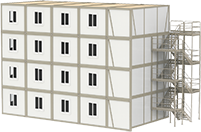
Standard container dimensions not only support global trade but also play a major role in modular construction projects. Today, containers are frequently used as offices, dormitories, healthcare units, classrooms, and temporary or permanent living spaces, especially in fast-deployment environments such as construction sites and disaster relief zones.
One of the most frequently searched topics in the container industry is the difference between 20 ft and 40 ft containers. Although both options share similar structural features, their capacity, flexibility, and application areas differ considerably.
A 20 ft container is compact, easy to transport, and cost-efficient. It is often preferred for smaller cargo volumes or limited installation areas. Due to its manageable size, it is widely used for storage purposes, small-scale logistics, and compact container buildings such as site offices, security cabins, and technical rooms.
In contrast, a 40 ft container offers nearly double the internal volume, making it ideal for high-volume cargo transportation and larger modular structures. Industries that require large storage capacity or expansive interior layouts often choose 40 ft containers. In construction and modular architecture, these containers are commonly converted into open-plan offices, accommodation units, cafeterias, or multi-purpose spaces.
Choosing between a 20 ft and a 40 ft container depends on factors such as available space, transportation logistics, budget, and intended use. Understanding these differences ensures that the selected container delivers maximum efficiency and functionality.
Container systems have evolved to meet diverse industrial and commercial demands. As a result, various container types have been developed, each serving a specific purpose. Understanding the types of containers helps businesses select the right solution for their operational needs.
Dry storage containers are the most widely used container type. They are designed for general cargo that does not require temperature control or special handling. These containers are fully enclosed, weather-resistant, and suitable for transporting construction materials, packaged goods, machinery parts, and household items.
Reefer containers, also known as refrigerated containers, are designed for temperature-sensitive cargo. They are equipped with integrated cooling systems that maintain consistent internal temperatures throughout transportation and storage. These containers are essential for industries dealing with food products, pharmaceuticals, and medical supplies.
Open-top containers are used when cargo height exceeds standard container dimensions or when top loading is required. Their removable roof structure allows oversized machinery, heavy equipment, or bulk materials to be loaded using cranes.
Tank containers are specialized units designed for transporting liquids, gases, and chemical products. They consist of a cylindrical tank mounted within a rectangular frame, providing both safety and compatibility with standard container handling systems.
Each container type is engineered with specific features that enhance safety, efficiency, and compliance with international transport regulations.
A common question in logistics is what is a refrigerated container used for. Reefer containers play a critical role in preserving product quality during long-distance transportation. These containers are capable of maintaining temperatures ranging from deep freezing to controlled cooling, depending on cargo requirements.
Food exporters rely heavily on reefer containers to transport fresh fruits, vegetables, meat, seafood, and dairy products. Similarly, pharmaceutical companies depend on refrigerated containers to ensure that medicines, vaccines, and biological materials remain stable and effective throughout transit.
Beyond transportation, reefer containers are also used as mobile cold storage units at ports, construction sites, agricultural facilities, and event venues. Their ability to function independently makes them an indispensable asset for temperature-sensitive operations.
Understanding the purpose of an open-top container is essential for industries dealing with heavy or oversized loads. These containers are specifically designed for cargo that cannot be easily loaded through standard container doors.
Open-top containers are commonly used in industrial sectors such as construction, mining, and manufacturing. Large machinery, steel structures, timber, and bulk materials can be placed inside from above using cranes or lifting equipment. After loading, the container is covered with a reinforced tarpaulin to protect the cargo during transport.
This container type provides flexibility without compromising structural integrity, making it an effective solution for complex logistical challenges.
Another frequently asked question is what is a tank container and what products is it used for. Tank containers are engineered to transport liquid, gaseous, and powdered substances safely and efficiently.
They are widely used in the chemical, food, and energy industries. Products such as edible oils, liquid sugar, milk, chemicals, fuels, and industrial gases are commonly transported using tank containers. Their design minimizes contamination risks and ensures compliance with strict safety regulations.
Tank container features include pressure resistance, corrosion protection, and temperature control options. These characteristics make them one of the safest and most reliable solutions for bulk liquid transportation.
Container sizes and usage areas vary depending on industry requirements and project scale. Smaller containers are often used for storage, mobile units, and temporary facilities, while larger containers support high-capacity logistics and modular construction projects.
In the construction sector, containers are used as on-site offices, accommodation units, dining halls, and sanitary facilities. In logistics and retail, they function as warehouses, distribution hubs, and pop-up stores. In emergency response and humanitarian aid, container systems provide fast and reliable shelter, healthcare units, and command centers.
Their modular nature allows containers to be combined, stacked, and customized, offering flexible solutions for both temporary and permanent applications.
A standard container is an ISO-certified transport unit designed with fixed dimensions to ensure compatibility across ships, trucks, and trains. These containers enable efficient global trade and are also widely used in modular construction.
A refrigerated container is used to transport and store temperature-sensitive goods such as food, pharmaceuticals, and medical products. It maintains controlled temperatures throughout the logistics process.
The purpose of an open-top container is to allow top loading of oversized or heavy cargo that cannot fit through standard container doors.
A tank container is a specialized container designed for transporting liquids, gases, and chemicals, including food-grade liquids and hazardous materials.
Logistics and retail industries prefer dry containers, food and pharmaceutical sectors rely on reefer containers, construction and heavy industry use open-top containers, and chemical and energy industries commonly use tank containers.
To provide you with better service, please email any questions or details regarding your theoretical and specialized architectural plans, projects, and product specifications to info@karmodkonteyner.com. We will respond to your request as soon as possible.


 EN
EN